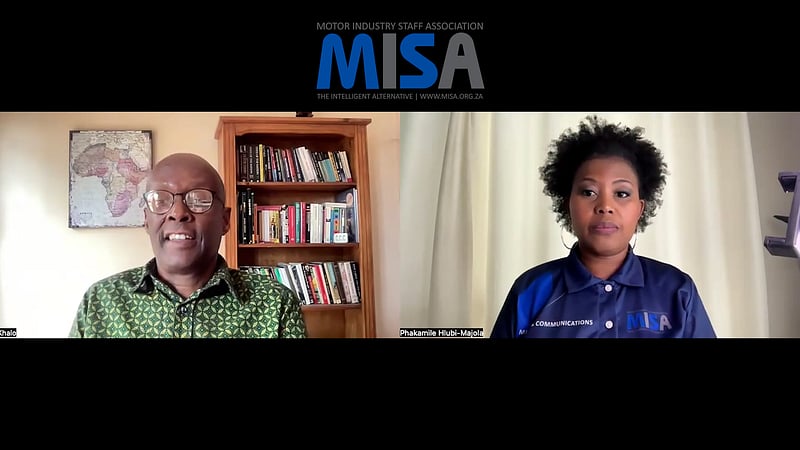
Look to Africa! Duma Gqubule urges trade diversification on MISAtv
16 November 2026
For immediate release
South Africa’s motor industry is finding new markets on its own continent. Vehicle exports to the rest of Africa rose by 36.4% in 2025, from 26 200 to 35 371 units, and Africa is now the industry’s second-largest export region. Economist Duma Gqubule says this is where South Africa’s trade future lies, in the latest interview on MISAtv.
According to Naamsa, the African continent accounted for R49.5 billion, or 17.0% of total automotive exports of R291.0 billion in 2025, with 85.1% of that export value destined for SADC, which is a free trade area.
"No worker's future should depend on a single market. Africa is buying more South African vehicles every year, and that means jobs in our factories and in the businesses that supply them. Government must back that growth with real support for the industry players who want to sell on the continent," says Martlé Keyter, Chief Executive Officer: Operations at MISA.
South Africa’s removal from AGOA emphasises the need to find new markets. AGOA is not a trade ban, however, South African exporters will pay a tariff. But the bigger blow to the motor industry is the 25% Section 232 tariff on vehicles and components. Vehicle exports to the United States fell by 83.2%, from 24 682 units in 2024 to 4 136 units in 2025. Gqubule says this is where the Department of Trade Industry and Competition (DTIC) should focus, on ways to mitigate against the negative impact of these tariffs.
The key is diversification, and Africa offers South Africa its best quality trade. In 2025, South Africa exported about R222 billion of goods to China, according to DTIC Minister Parks Tau, dominated by ores and minerals. By contrast, Gqubule points out, South Africa’s trade with the rest of the continent consists mostly of high-value manufactured and beneficiated goods, such as machinery, vehicles and chemicals.
Gqubule calls on the DTIC to find viable long-term solutions to the Section 232 tariff by bringing employers, trade unions, National Treasury and all relevant auto and motor stakeholders into one room. "It is technically possible to counter the negative effects of the U.S. trade policy by using a wide range of tools, and this would include diversifying our exports," he says.
He also warns that the high cost of energy is holding back growth and job creation. He believes the state must be involved in network industries such as electricity, water, telecommunications and transport, and that privatization has left businesses and households unable to afford energy. Electricity tariffs have risen by more than 900% since 2007, according to Electricity and Energy Minister Kgosientsho Ramokgopa.
"High energy costs hurt workers twice. Every electricity increase takes money out of household budgets, and it puts jobs at risk in businesses that can no longer afford to operate. Says Keyter. “MISA supports the call for government, business and labour to sit around one table and find solutions that protect jobs."
The latest episode of MISAtv is on YouTube now:
https://www.youtube.com/watch?v=-jnKRuvmRwo&t=212s
Issued by Sonja Carstens, Manager of MISA’s Media & Communication Department, on behalf of the Union. For media enquiries contact Phakamile Hlubi-Majola, Spokesperson of MISA, on 083 367 6417 or [email protected]
#PROUDLYMISA #MISALEADS #MISACARES #MISAONTHEMOVE #MISAFAMILY